Psychedelic Policy Is Changing Across the U.S. What States Are Doing in 2026 From regulated access and facilitator protections to psilocybin rescheduling and state-supported ibogaine research, psychedelic policy is taking very different forms across the country. Psychedelic policy is changing across the United States, but states are taking very different approaches. In 2026, some are […]
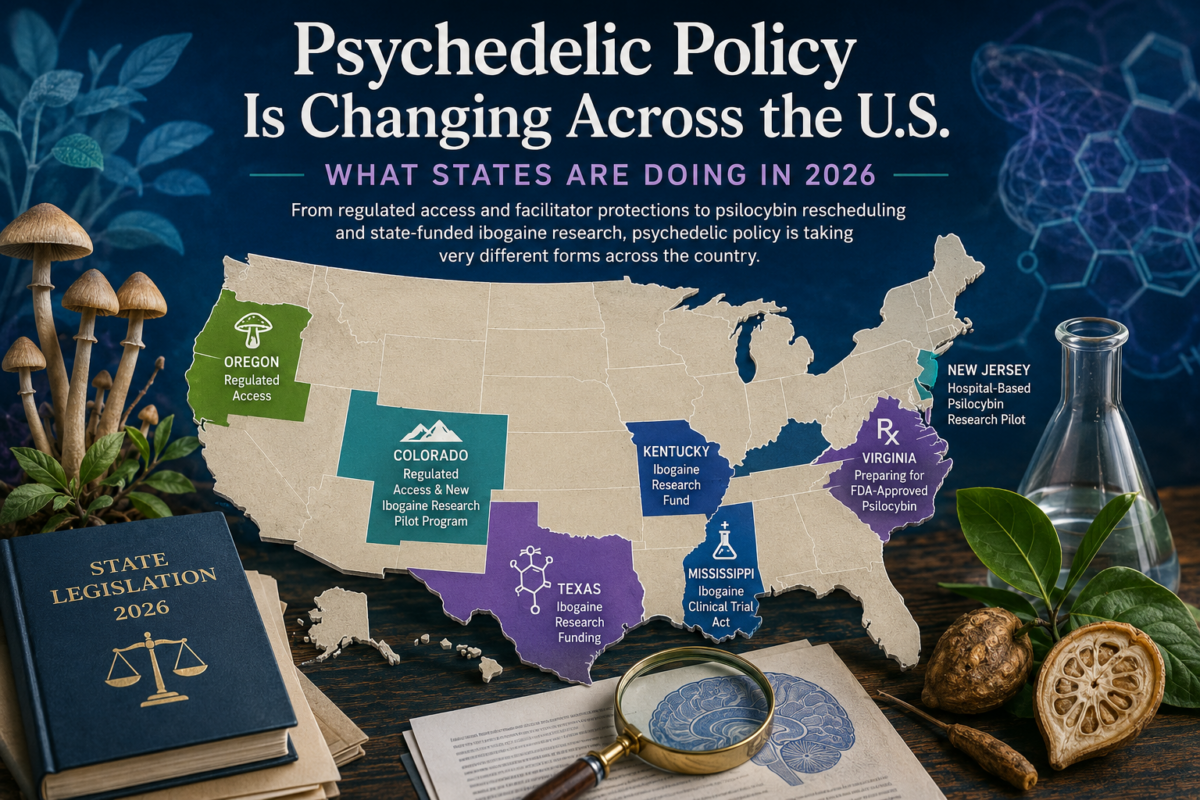
From regulated access and facilitator protections to psilocybin rescheduling and state-supported ibogaine research, psychedelic policy is taking very different forms across the country.
Psychedelic policy is changing across the United States, but states are taking very different approaches. In 2026, some are refining regulated access programs, while others are supporting psychedelic research or preparing their laws for the possibility of future FDA-approved treatments. Understanding psychedelic policy in 2026 requires looking closely at what individual states are actually authorizing.
When headlines describe a state as advancing “psychedelic reform,” the phrase can cover very different policies.
A state might authorize clinical research without allowing public access. Another might prepare to reschedule a psychedelic medication only if it receives federal approval. Colorado and Oregon have gone further by creating regulated systems through which adults can access certain psychedelic services without a prescription.
The differences matter, particularly as more states consider legislation involving psilocybin, ibogaine, and psychedelic-assisted care.
Colorado represents one of the most developed examples of changing psychedelic policy in 2026. Colorado is entering a new stage of psychedelic policy. Rather than deciding whether to establish regulated natural medicine, lawmakers are now addressing what happens after that system begins operating.
In June 2026, Governor Jared Polis signed House Bill 26-1325, which makes several changes to Colorado’s natural medicine framework. The law became effective August 12, 2026.
Among its provisions, HB26-1325 establishes an ibogaine research pilot program within the state’s Behavioral Health Administration. The program is intended to study the safety and effectiveness of ibogaine for mental health conditions and substance use disorders and may include up to five pilot sites.
The law also addresses facilitator liability, licensing and enforcement, and certain services surrounding Colorado’s regulated natural medicine system. For example, it establishes protections from liability for facilitators performing or supervising natural medicine services, except in circumstances involving intentional misconduct, gross negligence, or deviation from the recognized standard of care.
These changes illustrate a challenge that other states may eventually face. Creating a legal framework is only the beginning. Regulators must continue deciding how facilitators, participants, researchers, support services, and enforcement fit within the system as it develops.
Ibogaine has become one of the most significant psychedelic policy stories in the United States.
The psychoactive compound is derived from Tabernanthe iboga, a plant native to Central Africa with longstanding ceremonial importance within Bwiti traditions. Researchers are studying ibogaine for possible applications involving substance use disorders and other conditions, although it has not been approved by the FDA as a treatment.
Texas made national headlines after lawmakers committed $50 million toward ibogaine research and drug development. The state’s framework was designed to support clinical trials intended to pursue FDA approval. In March 2026, Texas officials announced that the state planned to move forward with its own research program after proposals from drug developers had not met the requirements established for the original public-private model.
Other states are moving in similar directions. Kentucky enacted SB77 in 2026, establishing an ibogaine research and intellectual property development fund after lawmakers overrode the governor’s veto. Mississippi’s Ibogaine Drug Development Clinical Trial Act took effect July 1 and creates a framework for FDA-coordinated clinical research. Colorado’s new pilot program represents another approach to studying the substance.
The growing interest comes with important safety considerations. Ibogaine has been associated with QT prolongation and potentially life-threatening heart rhythm abnormalities. A 2026 review in Addiction emphasized the importance of careful cardiovascular screening and monitoring in future clinical use.
Interest in ibogaine also raises questions beyond clinical safety. Growing international demand for iboga has created concerns about overharvesting and access to the plant in Gabon. Researchers and policymakers will increasingly need to consider conservation, sustainable sourcing, and the cultural significance of iboga to Indigenous Bwiti communities as research expands.
Another approach does not create immediate access to psychedelics at all. Instead, states are preparing their laws for a future in which the FDA approves a psilocybin-based medication.
In Virginia, a law enacted in 2026 directs the Virginia Board of Pharmacy to reschedule an FDA-approved formulation of psilocybin following corresponding federal scheduling changes. The law does not create psilocybin service centers or broadly legalize psychedelic mushrooms. Its effect depends on future federal action.
This type of legislation could become increasingly important if psychedelic drug development continues progressing through clinical trials. It allows states to prepare their controlled-substance laws before a federally approved psychedelic medication reaches clinical practice.
New Jersey illustrates that Research-focused legislation is another important part of psychedelic policy in 2026.”Earlier versions of legislation in the state proposed a broader framework for regulated psilocybin access. By January 2026, however, lawmakers had revised the proposal into the Psilocybin Behavioral Health Access and Therapy Pilot Program.
The revised model focuses on hospital-based research conducted in accordance with FDA and Drug Enforcement Administration requirements. The legislation provides for three participating hospitals and proposes $6 million in funding, with $2 million allocated to each participating hospital.
That is considerably different from creating a statewide adult-access system. Participants would encounter psilocybin through structured research rather than through state-licensed service centers.
The shift demonstrates how psychedelic legislation can change significantly during the policymaking process. A bill that begins as an access proposal may ultimately become a research program.
Colorado and Oregon remain distinct because both states have established systems allowing adults to access regulated psilocybin services without waiting for an FDA-approved prescription medication.
Oregon’s system includes licensed facilitators and service centers, with preparation, administration, and integration sessions forming part of the regulated process. Clients must be at least 21, and psilocybin is consumed at a licensed service center during an administration session with a licensed facilitator.
Colorado created its own natural medicine framework following voter approval of Proposition 122 in 2022. Its system differs from Oregon’s in important ways, particularly around personal use and the structure of natural medicine services.
Neither model changes federal law. Psilocybin remains federally controlled, creating an unusual situation in which activity authorized under state law may remain prohibited federally.
For people following psychedelic policy, the details behind a new law may matter more than the headline announcing it.
Researchers may see new opportunities for clinical studies and public funding. Facilitators may encounter new licensing requirements, liability protections, or professional standards. Healthcare professionals may eventually need to understand how FDA approval and federal rescheduling interact with state law. People seeking psychedelic services may find that access available in one state does not exist across the state line.
Policy choices also affect Indigenous communities connected to psychedelic and plant medicine traditions. As interest in substances such as iboga grows, questions of conservation, reciprocity, cultural respect, and sustainable sourcing deserve a place alongside discussions about research and commercialization.
The U.S. psychedelic policy landscape is likely to keep changing. Some states are already implementing laws, while others are considering research programs, medical pathways, or changes that would take effect following federal approval.
Federal policy will remain a major part of this picture. State legislation can create research programs or authorize activities under state law, but it does not automatically remove federal restrictions. As psychedelic policy in 2026 continues to develop, federal and state laws may move in very different directions.
For anyone following psychedelic policy in 2026, asking whether a state has “legalized psychedelics” is becoming less useful. A better question is what the state has actually authorized: research, future medical access, regulated services, personal use, or some combination of these approaches.
If you are currently struggling after a challenging psychedelic experience and do not want to wait for the rest of this series, you can explore support through AURA or book a free appointment with one of our psychedelic information specialists.
If you’re looking for personalized guidance and support before or after a psychedelic experience, the Unlimited Sciences Psychedelic Info Line offers free, 1:1 support for answering questions about psychedelic safety, integration, and emotional processing. You can also Chat with AURA AI, 24/7, for free.
No comment yet.
Join our email list and get immediate access to part one of our psilocybin guide. You’ll also get the latest in how we’re bridging the gap between science and soul: psychedelic research updates, real-world findings, community-driven education, personal stories and expert insights on natural medicine.
Advancing Real-World Psychedelic Research and Science-Backed Education
Unlimited Sciences is provided with a nonprofit status by fiscal sponsorship through Realm of Caring Foundation.
Federal EIN: 46-3371348.
© 2025 Unlimited Sciences. All Rights Reserved.
Designed by Gloss