Ketamine vs. Esketamine How Ketamine and Esketamine Differ Ketamine and esketamine are closely related, but they are not the same medication. Learn how they differ in chemical structure, formulation, clinical use, FDA approval, and current research. If you’ve been researching ketamine therapy, you’ve probably come across the terms ketamine and esketamine. Although they sound nearly […]
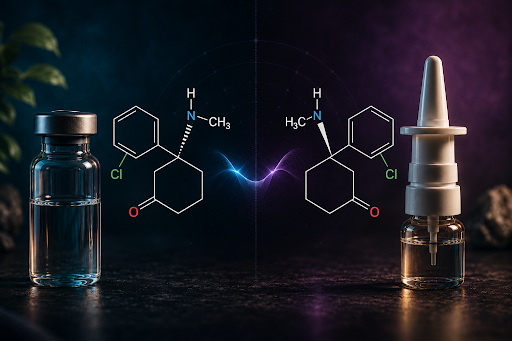
Ketamine and esketamine are closely related, but they are not the same medication. Learn how they differ in chemical structure, formulation, clinical use, FDA approval, and current research.
If you’ve been researching ketamine therapy, you’ve probably come across the terms ketamine and esketamine. Although they sound nearly identical, they are not the same medication.
Both originate from the same parent compound, but they differ in their chemical structures, formulations, and current use in clinical practice.
Understanding these differences can help you better interpret research studies, treatment options, and conversations with healthcare professionals.
Ketamine contains two molecules with the same atoms arranged differently in three-dimensional space.These are called enantiomers, or mirror-image molecules.
You can think of them like your left and right hands. They have the same parts, but their shapes prevent them from lining up perfectly with one another.
The two enantiomers are:
Together, they form what is known as racemic ketamine, the formulation that has been used as an anesthetic for decades.
Esketamine contains only the S-ketamine molecule.
Researchers found that S-ketamine has a stronger affinity for the N-methyl-D-aspartate (NMDA) receptor than R-ketamine. This led to the development of esketamine as a separate medication for psychiatric treatment.
Today, esketamine is available as a prescription nasal spray. It is FDA-approved for treatment-resistant depression in adults, either on its own or alongside an oral antidepressant. It is also approved, in conjunction with an oral antidepressant, for depressive symptoms in adults with major depressive disorder accompanied by acute suicidal ideation or behavior. Esketamine is administered under medical supervision through the FDA’s Risk Evaluation and Mitigation Strategy (REMS) program.
Racemic ketamine contains both R-ketamine and S-ketamine in equal amounts.
The FDA has approved racemic ketamine as an anesthetic. Some healthcare providers also prescribe it off-label for depression and other conditions based on clinical judgment and the available evidence.
Off-label prescribing is common throughout medicine. It means a medication is being prescribed for a condition that has not received FDA approval, even though scientific evidence or clinical experience may support its use.
Both ketamine and esketamine affect glutamate signaling and interact with NMDA receptors, but they are not identical.
Researchers believe both medications ultimately promote changes in brain connectivity and synaptic plasticity. However, they differ in several ways, including:
Current research does not provide a simple answer. Some systematic reviews have found differences in response and remission outcomes between intravenous racemic ketamine and intranasal esketamine, but differences in study design, route of administration, dosing, and patient populations make direct comparisons difficult.
The second mirror-image molecule, R-ketamine, is also receiving increasing scientific attention.
Early research suggests that R-ketamine may have antidepressant potential, but human research remains limited. Researchers are continuing to investigate its effectiveness, safety, and potential side-effect profile compared with other forms of ketamine.
At this time, R-ketamine has not been approved by the FDA for treating depression, and much more research is needed before its potential role can be fully understood.
This is one reason reading headlines can be confusing. Older studies often investigated intravenous racemic ketamine because it was already available as an anesthetic.
More recent studies frequently examine esketamine because the FDA approved it specifically for psychiatric treatment.
As a result, researchers cannot always apply findings from one form of ketamine to another.When reading about a study, it is helpful to note:
These details can influence how researchers interpret the results.
Current research does not provide a simple answer.
Esketamine has undergone the clinical trials required for FDA approval in specific psychiatric conditions. Racemic ketamine has a larger body of research spanning several decades and continues to be studied in a variety of clinical settings.
Researchers are also investigating R-ketamine as a possible future treatment.
Rather than asking which medication is “better,” scientists are working to understand which treatment may be most appropriate for different individuals under different clinical circumstances.
Although ketamine and esketamine are closely related, they are not the same medication.
Racemic ketamine contains both R-ketamine and S-ketamine. Esketamine contains only the S-ketamine molecule and is FDA-approved for certain forms of depression when administered under medical supervision.
Research on all three forms continues to evolve. As scientists learn more, our understanding of how these medications work, who they may help, and how they can be used safely will continue to grow.
Continue exploring the Psychedelic Science Explained: Ketamine series:
If you’re looking for personalized guidance and support before or after a psychedelic experience, the Unlimited Sciences Psychedelic Info Line offers free, 1:1 support for answering questions about psychedelic safety, integration, and emotional processing. You can also Chat with AURA AI, 24/7, for free.
No comment yet.
Join our email list and get immediate access to part one of our psilocybin guide. You’ll also get the latest in how we’re bridging the gap between science and soul: psychedelic research updates, real-world findings, community-driven education, personal stories and expert insights on natural medicine.
Advancing Real-World Psychedelic Research and Science-Backed Education
Unlimited Sciences is provided with a nonprofit status by fiscal sponsorship through Realm of Caring Foundation.
Federal EIN: 46-3371348.
© 2025 Unlimited Sciences. All Rights Reserved.
Designed by Gloss