
OUR CONTINUED PURPOSE
2025 Annual Impact Report
Inspired Innovation, Continued Expansion and Efficiencies
Feedback Loops that Bridge Data and the Human Experience
By listening first, we identify the critical gaps where research hasn't yet caught up to human need. These gaps become our call-to-action, fueling our Community Research Roadmap and the development of accessible tools like our online courses and blog library. In 2025, we're proud to share how this unique model (where every conversation informs a study and every study empowers a caller) is accelerating our collective understanding of psychedelic safety and efficacy.

Our mission is to advance the conversation around psychedelics with integrity, empathy and evidence.

"Reflecting on 2025, I'm incredibly proud of our progress. Our team continues to bridge critical data gaps by staying deeply rooted in the needs of the community. Truly driven by the people, for the people, we enter the new year with immense inspiration and gratitude.
— Katie Pickard, Executive Director
2025 Research Accomplishments
Our Mission for Psychedelic Research: We generate real-world evidence on psychedelic use, translating lived experience into scientific insight and actionable guidance to inform practice, policy, and human flourishing.

Initial Scoping and Partnerships for Project IRIS
In 2025, we completed the initial scoping and partnerships for Project IRIS (In situ Registry of Insights and Stories). A landmark longitudinal study on non-facilitated use, we're hoping to launch Project IRIS in 2026.
By aligning Unlimited Sciences data with industry-leading research on facilitated use (with partners like OPEN and RMPDS), IRIS will contribute to the largest combined, holistic view of psychedelic use ever created. As we work toward kick off, we’re looking for two kinds of help: participants and donors.
Partnership in End-of-Life Ketamine Study
We were proud to be selected as a partner with EOLPC for their Home-Based Ketamine and Spiritual Care (HBKS) project. This collaborative effort, supported by a grant from Healing Hearts, Changing Minds, pilots a community model delivering ketamine therapy and spiritual care to in-home palliative care patients.
In 2026, we'll provide comprehensive data analysis and reporting for the pilot. By analyzing both qualitative narratives and quantitative shifts, our work will help scale compassionate, end-of-life care nationwide.
5 Published Papers in 2025
- 📑 Shame, Guilt and Psychedelic Experience: Results from a Prospective, Longitudinal Survey of Real-World Psilocybin Use Journal of Psychoactive Drugs, February 2025
Conducted with 679 adults who used psilocybin in naturalistic settings, the study explored how shame and guilt manifested during psychedelic experiences and how these emotions impacted well-being both before and after the experience. Participants were surveyed to track changes in emotional states and their potential long-term effects. Read our blog about the research for an overview.
- 📑 Patterns of Internalizing Problems, Substance Use and Cognitive Flexibility Before and After Naturalistic Psilocybin Use: A Repeated Measures Latent Profile Analysis International Journal of Mental Health and Addiction, March 2025
While clinical trials have shown the promise of psilocybin in treating depression, anxiety, and substance use disorders, much less is known about how it affects people who use it outside of therapeutic settings. This research offers groundbreaking insights by analyzing mental health outcomes in thousands of people who used psilocybin in naturalistic environments. Read our blog about the research for an overview. - 📑 LGBTQ+ Ayahuasca Retreat Experience is Associated with Benefits to Mental Health, Quality of Life, and Spiritual Well-being: A Prospective, Naturalistic Study (Preprint), June 2025
In partnership with the Queer Wellness Collective and the Jungle Gayborhood, we conducted a naturalistic study with LGBTQ+ participants at an ayahuasca retreat in Costa Rica. The study examined the impact on mental health, identity, social well-being, and more. Read our blog about the research for an overview.
- 📑 A lexicon for psychedelic research and treatment Drug Science, Policy and Law, September 2025
Despite much progress in psychedelic research, the field lacks standardized terminology to guide clinical development, dosing, safety monitoring, and regulatory classification. Here, we present a comprehensive framework for psychedelic nomenclature based on pharmacology, subjective effects, dosing, and therapeutic use. Read our blog about the research for an overview. - 📑 "Functional mushrooms saved my daughter’s life": A preliminary mixed methods survey study of Reishi (Ganoderma lucidum) and lion’s mane (Hericium erinaceus) for epilepsy Pharmacological Research - Natural Products, October 2025
We were excited to partner with Realm of Caring and Lily’s Lighthouse on some incredible new research about the impact functional mushrooms on seizure disorders. This study represents a critical, early step in exploring a readily available, natural, and low-cost complementary therapy for a condition that drastically affects millions globally. Read our blog about the research for an overview.
2025 Research Grant Applications
- John Templeton Foundation: Applied for $324,150 - Not Selected
- Healing Hearts, Changing Minds: Applied for $68,000 - Not Selected
- Healing Hearts, Changing Minds (via EOLPC): Applied for $12,000 - Selected as Collaborator
- Chinook Foundation: Applied for $10,000 - Not Selected
- Tiny Blue Dot Foundation: Applied for $495,075 - Not Selected
- Conciousness Foundation: Applied for $100,000 - Invited to Submit Full Proposal
- Open Access AI and Mental Health: Applied for $100,000 - Not Selected
2025 Educational Milestones
In 2025, our educational efforts saw an unprecedented level of momentum. We posted 49 blog articles that translate study findings into practical guidance. We partnered with 11 media outlets to promote our mission. And we were asked to speak to eight different communities as expert speakers to educate the community.

The Beta Launch of AURA
We're building the world’s largest evidence-based and community-sourced conversational AI model for psychedelic natural medicine. Launched to Beta testers in late 2025, AURA offers compassionate, non-judgmental answers to your most pressing psychedelic questions about natural medicine. Test the Beta version.
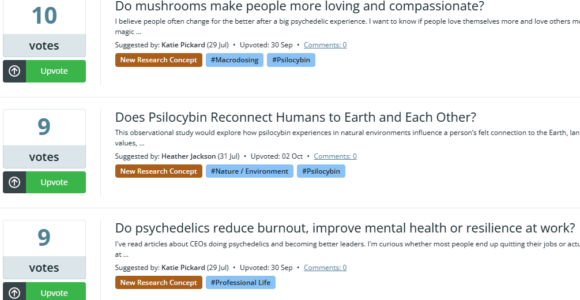
Community Research Roadmap
We're turning your questions into a call-to-action. By crowdsourcing ideas for new research, we prioritize what matters most to the communities we serve. This tool gives voice to the people, helping us showcase the greatest research needs and helping us prioritize funding requests. Upvote and submit ideas on the roadmap.
Our Flagship Educational Service: The Psychedelic Info Line
We launched the Psychedelic Info Line in 2024 as a free, confidential service connecting the public with trained navigators. Moving beyond anecdotes, we provide 30-minute, evidence-based consultations to empower people to make informed, safe choices.
This service is our most vital community touchpoint. Data from our first 18 months revealed a diverse reach:
- 47% of callers are over 55
- 31% have never used psychedelics
- 71% of our calls are about magic mushrooms
- 44% of calls are about mental health
Spanning 30 states, these conversations ensure our research remains "by the people," directly reflecting the real-world needs of the community we serve.
This year, we also developed a better sense of who calls the Psychedelic Info Line:
- Cautious First-Timers: Want to explore personal healing but has questions and seeks reassurance
- Psychedelic Explorers: Want to make sense of past experiences or learn about new substances
- Concerned Loved Ones: Want to offer informed, responsible support to someone they know, personally or professionally
In Development: New Online Course Curriculum
Looking Ahead to 2026
We enter 2026 with immense momentum: scaling accessibility in education (with the launch of AURA) and building a multi-year psychedelic registry (Project IRIS). Beyond those two key initiatives, our priorities include:
2026 Strategic Priorities
 Receive IRB approval to analyze our Psychedelic Info Line data
- Connect our Community Research Roadmap to Donor Priorities
- Publish 3-5 Academic Papers
- Target Outreach Campaigns to Decriminalized Areas
- Significantly Grow Content Strategy for Free Resources
- Create and Launch a Volunteer Certification Program
- Expand our Suite of Online Courses and Launch Live Workshops
- Increase Staff Pay Rates and Hours
The People Behind the Progress
In addition to our staff, we have a team of dedicated volunteers who actively contribute to our research and education initiatives. Our work would not be possible without their generous contributions. Ongoing thanks goes to to Quinn, Owen, Lisa, Dena, and Zac.



Fund Our Work and Be Part of Our Story
Every contribution directly funds Real-World Psychedelic Research and the Psychedelic Info Line. Our work sustains an ecosystem that identifies research gaps and translates data into practical community education.