How to Test Your Drugs: Part 1 of 7: A Beginner’s Guide Psychedelic drug safety is an important part of understanding both the potential benefits and risks associated with psychedelic use. Research continues to clarify how factors such as health history, medications, dosage, setting, and substance combinations may influence safety. When people obtain substances outside […]
Psychedelic drug safety is an important part of understanding both the potential benefits and risks associated with psychedelic use. Research continues to clarify how factors such as health history, medications, dosage, setting, and substance combinations may influence safety.
When people obtain substances outside a regulated pharmaceutical supply, appearance, packaging, smell, and seller descriptions may offer little reliable information about what the substance actually contains. Powders, pills, crystals, blotter, capsules, and other products can contain unexpected substances, substitutions, or additional compounds that may change their effects and risks.
Drug checking is one harm reduction strategy that can provide more information before someone uses a substance. Depending on the method, testing may help identify an expected substance, detect certain unexpected compounds, or indicate that more advanced analysis is needed. However, every testing method has limits. A result can provide useful information without proving that a substance is safe, pure, or appropriate for a particular person.
For this reason, drug checking works best when it is understood as one part of a broader harm reduction approach. Testing can reduce some uncertainty, but it does not replace attention to dose, possible interactions, physical and mental health, the setting in which a substance is used, or access to help if something goes wrong.
Drug checking refers to a range of methods used to gather information about a substance’s contents. These methods vary considerably in complexity. Some are inexpensive tools you can use at home or in community settings, while others rely on specialized equipment or laboratory analysis.
The type of information a test provides depends on the technology being used. Some methods look for a particular substance or drug class, while others can identify multiple compounds in a sample. More advanced methods may provide a broader chemical profile, but even sophisticated testing does not necessarily identify every substance present or determine exactly how a person will respond.
Individuals, harm reduction organizations, public health programs, researchers, and community-based services use drug checking. Beyond helping one person understand a particular sample, anonymous drug-checking data can also help public health groups identify changes in the unregulated drug supply. This can include the appearance of new adulterants, unexpected substitutions, or emerging patterns that may affect community safety.
There are many reasons someone may choose to test a substance. A person may want to know whether a product appears consistent with what they expected to receive, whether a known contaminant may be present, or whether additional testing would be worthwhile before deciding what to do next.
Testing may be especially relevant when substances are obtained from an unregulated market, where appearance and packaging offer limited information about chemical contents. Counterfeit pills, mislabeled powders, and unexpected mixtures can all occur. A substance may contain the expected drug but also include undisclosed compounds.
Some people use drug checking because they are concerned about specific high-risk contaminants. Others may simply want more information before deciding. More broadly, drug checking can also support community harm reduction when testing programs identify unexpected substances and share those findings through alerts or public health reporting.
The common thread is uncertainty. Drug checking cannot remove all of it, but it can sometimes replace assumptions with more useful information.
Several forms of drug checking are available, and each one has different strengths and limitations. No single method can answer every question about a substance.
Some approaches are designed for rapid screening and can be relatively accessible. Others require trained staff or specialized equipment but may provide more detailed information. In some settings, multiple methods are used together because one test may detect something that another does not.
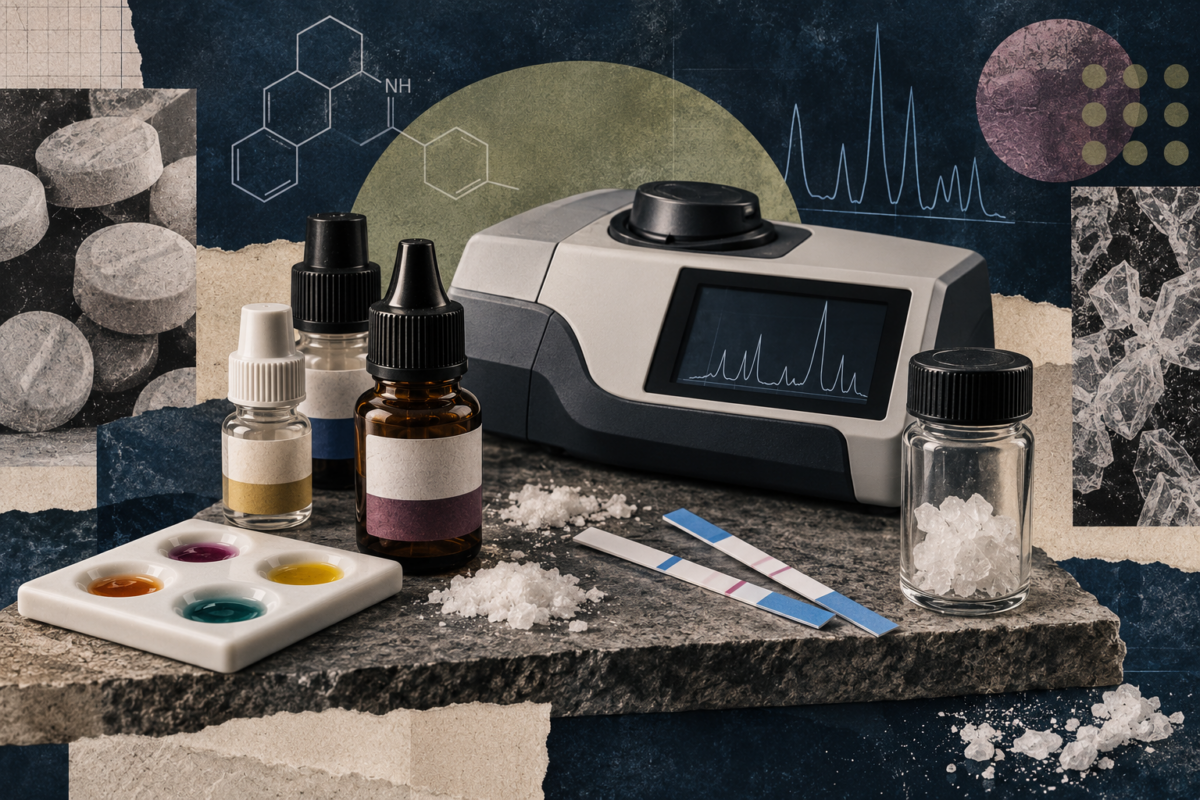
Reagent tests use chemical solutions that change color when they react with certain compounds. They are among the most widely recognized forms of at-home drug checking because they are relatively inexpensive, portable, and do not require advanced equipment.
A reagent result may suggest that a particular substance or drug class is present based on the color reaction. Using more than one reagent can sometimes provide additional information and help narrow the range of possibilities.
Reagent tests are still screening tools. They generally cannot confirm purity, determine exact potency, or reliably identify every substance in a mixture. Color reactions may also be difficult to interpret, especially when multiple compounds are present. A result that appears consistent with an expected substance does not prove that nothing else is in the sample.
This is why reagent testing is often most useful when viewed as one piece of information rather than a final answer about a substance.
Fentanyl test strips are designed to detect fentanyl and many related compounds in a prepared sample. They have become an important harm reduction tool because fentanyl can appear in substances where someone may not expect an opioid to be present.
A positive result suggests that fentanyl or a substance detected by the strip may be present. A negative result can reduce some uncertainty, but it does not guarantee that the entire supply is free from fentanyl or other contaminants.
One limitation is sampling. A small portion taken from a larger supply may not perfectly represent everything in that supply, particularly if substances are distributed unevenly. Test performance can also be affected by how a sample is prepared, the concentration of compounds present, and the specific substance being tested.
Fentanyl test strips are also designed to answer a narrow question. They may provide information about fentanyl, but they do not tell someone everything else that could be present in the sample.
Fourier-transform infrared spectroscopy, usually called FTIR, uses infrared light to analyze a substance’s chemical characteristics. Some community drug-checking programs, festivals, research projects, and harm reduction services use FTIR because it can identify a wider range of substances relatively quickly.
Unlike a reagent test or fentanyl strip, which may focus on a particular reaction or contaminant, FTIR can provide a broader picture of the major compounds in a sample. This makes it useful for identifying unexpected substitutions and mixtures that may not be apparent from appearance alone.
FTIR also has limitations. Compounds present in very small amounts can sometimes be difficult to detect, particularly when another substance makes up most of the sample. Because of this, some drug-checking programs pair FTIR with other technologies or targeted test strips when they are concerned about contaminants that may be present at low concentrations.
Laboratory methods such as gas chromatography-mass spectrometry, or GC-MS, and liquid chromatography-mass spectrometry, or LC-MS, can provide more detailed chemical analysis than many field-based methods.
These techniques can separate components within a sample and identify individual compounds with high precision. They may be particularly useful when a sample contains multiple substances, when simpler testing produces an unclear result, or when more detailed confirmation is needed.
Laboratory testing can still have practical limitations. It may require mailing or delivery, results may take longer, and access varies by location. Some services may also be expensive or unavailable to the public.
The greater precision of laboratory analysis does not change one central principle of drug checking: even knowing what is present does not make a substance risk-free.
Drug checking can provide information that would otherwise be difficult or impossible to obtain by looking at a substance.
Depending on the method used, testing may help identify whether an expected substance appears to be present, whether certain unexpected compounds can be detected, or whether the sample contains a mixture of substances. More advanced testing can sometimes provide a much more detailed chemical profile.
This information can affect decision-making. Someone may choose not to use a substance after an unexpected result, seek additional testing, reconsider dose or setting, or take other harm reduction precautions based on what they learn.
Drug checking can therefore be valuable even when it does not provide absolute certainty. The key is understanding the result in the context of what that particular testing method was designed to detect.
One of the most important parts of drug checking is understanding what a test cannot establish.
Testing cannot guarantee that a substance is safe. A negative result for one contaminant does not mean that no other unexpected substances are present, and testing one portion of a sample may not accurately represent another portion if compounds are distributed unevenly.
Many commonly available testing methods cannot determine exact potency or dosage. Even when a substance is correctly identified, the amount present may vary significantly between products or batches.
Drug checking also cannot predict how a particular person will respond. Effects and risks can be influenced by dose, medications, physical health, mental health history, tolerance, sleep, hydration, other substances being used, and the environment in which the experience takes place.
Some drugs also carry meaningful risks even when they are exactly what someone expected them to be. Testing can provide information about identity or contamination, but it does not remove the substance’s pharmacological risks.
Because different testing methods answer different questions, using more than one approach can sometimes provide a clearer picture.
For example, a reagent test may suggest that an expected drug class is present, while a fentanyl strip may screen for a specific high-risk contaminant. FTIR may provide broader information about major compounds in a sample, while laboratory analysis may be used when more precise identification is needed.
Using multiple methods does not create certainty, and more testing does not automatically mean a substance is safe. It can, however, reduce some of the blind spots that come with relying on a single tool.
The best testing approach depends on the substance, available resources, and what someone is trying to learn.
Harm reduction starts from the reality that people make different decisions about substance use. The goal is to provide practical information and tools that may reduce risk, without assuming that everyone will make the same choices.
Drug checking fits within this approach because it can reduce uncertainty about what a sample may contain. That information can support more informed decision-making, particularly when combined with other harm reduction practices.
Testing is only one part of the picture. Dose, drug interactions, physical and mental health conditions, tolerance, hydration, environment, and access to trusted support can all affect risk. Combining substances can also create effects that are difficult to predict, even when each individual substance has been identified.
People who are pregnant, have certain medical or psychiatric conditions, or take medications that may interact with a substance may face additional risks. In these situations, knowing what a substance contains does not necessarily make use appropriate or safe.
Emergency symptoms such as difficulty breathing, severe chest pain, seizures, extreme overheating, loss of consciousness, or being unable to wake someone require immediate medical attention.
Access to drug checking varies by location. Some communities offer testing through harm reduction organizations, public health programs, festivals, or community events. In other places, laboratory or mail-in testing may be available where legally permitted.
Some organizations also provide reagent kits, fentanyl test strips, educational materials, or information about local services. Because testing availability and laws differ across regions, check what options exist where you live.
This article is the starting point for our Drug Safety Series. Upcoming articles will take a closer look at individual drug-checking tools, what results mean, and the limitations you need to understand.
Future topics in this series include:
Drug checking cannot eliminate the risks associated with substance use. It can, however, provide information that may otherwise be unavailable and help people make decisions with a clearer understanding of what may be present in a substance.
If you’re looking for personalized guidance and support before or after a psychedelic experience, the Unlimited Sciences Psychedelic Info Line offers free, 1:1 support for answering questions about psychedelic safety, integration, and emotional processing. You can also Chat with AURA AI, 24/7, for free.
No comment yet.
Join our email list and get immediate access to part one of our psilocybin guide. You’ll also get the latest in how we’re bridging the gap between science and soul: psychedelic research updates, real-world findings, community-driven education, personal stories and expert insights on natural medicine.
Advancing Real-World Psychedelic Research and Science-Backed Education
Unlimited Sciences is provided with a nonprofit status by fiscal sponsorship through Realm of Caring Foundation.
Federal EIN: 46-3371348.
© 2025 Unlimited Sciences. All Rights Reserved.
Designed by Gloss