What Is Process Art? You Don’t Have to Be an Artist Process art focuses on the experience of creating rather than the quality of the finished artwork. You don’t need artistic training or even to consider yourself creative to explore it. In Part 1 of our Beyond Words: Art, Psychedelics, and Integration series, we explore […]
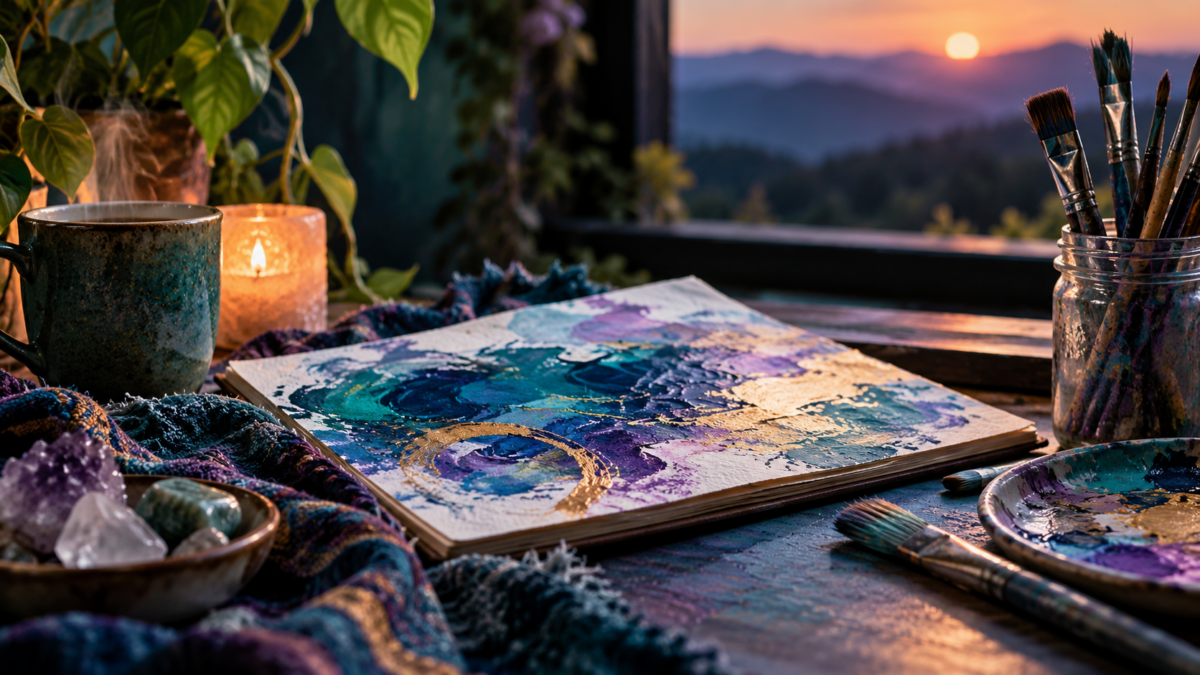
Process art focuses on the experience of creating rather than the quality of the finished artwork. You don’t need artistic training or even to consider yourself creative to explore it. In Part 1 of our Beyond Words: Art, Psychedelics, and Integration series, we explore what process art is, why artistic ability isn’t required, and how this approach can offer a foundation for exploring experiences that are difficult to put into words.
For many adults, the invitation to make art can bring up an immediate response: “I’m not an artist.” Somewhere between childhood finger painting and adulthood, creativity often becomes connected to ability. Drawing becomes something you are either good or bad at. Painting starts to feel like something that requires skill, and people may judge what they create by whether the finished piece looks good.
Process art approaches creativity very differently. Instead of focusing primarily on the finished artwork, it focuses on the experience of making it. The colors you choose, the movements you make, and the materials that catch your attention all become part of the experience. Thoughts, emotions, memories, and sensations that arise along the way can matter too. The finished piece may be beautiful, messy, recognizable, completely abstract, or something you decide to throw away afterward.
This distinction becomes especially interesting when we begin thinking about art in relation to psychedelic experiences. People do not always remember or understand psychedelic experiences as straightforward stories. Sometimes what remains is an image, a color, a pattern, a bodily sensation, or a hard-to-explain feeling. Before we explore creative practices for psychedelic integration in Part 2, it helps to start with the foundation. What is process art, and why don’t you need to consider yourself an artist to explore it?
Imagine you sit down to draw a tree. If your goal is to create a realistic tree, you may quickly begin evaluating what you are making. Are the proportions right? Do the branches look believable? Does this actually look like a tree? Your attention naturally moves toward the quality of the finished product.
Now imagine sitting down with the same paper without deciding what you are going to create. Now imagine sitting down with the same paper without deciding what you are going to create. Green catches your attention, so you begin making marks with it. From there, you might add another color, change the pressure of your pencil, cover something you previously drew, or notice that a particular shape keeps appearing. Eventually, the page may become something recognizable, or it may remain filled entirely with colors and shapes.
In process art, the second experience is the point. There is less emphasis on producing a particular result and more room to notice what happens as you create. This can include experimenting with materials, following curiosity, responding to emotions or sensations, and allowing an image to develop without deciding in advance what it needs to become.
That also means no one needs to understand what you made. A black circle surrounded by yellow might have enormous personal significance, or it might simply be the combination of colors and shapes you wanted to make that day. Process art doesn’t require every creative decision to carry a hidden psychological meaning.
One of the biggest barriers to using creative expression is the belief that art is primarily for people who are good at making it. Process-oriented art gives us a chance to set that assumption aside.
A stick figure can represent a memory. A page filled with red scribbles can represent an emotion. A collection of shapes can represent different people, places, or moments. Clay can simply be squeezed, flattened, pulled apart, and reshaped. None of these activities requires technical training, and none needs to result in something you would want to hang on a wall.
Research into art-making provides some interesting context for this idea. In a small 2016 study, 39 healthy adults participated in 45 minutes of art-making using materials including paper, markers, collage materials, and clay. Researchers measured cortisol, a hormone involved in the body’s stress response, before and after the activity. Cortisol levels decreased in approximately 75 percent of participants, and researchers found no significant relationship between prior art-making experience and the change in cortisol levels.
This was a small study without a control group, so it should not be interpreted as evidence that making art will reliably reduce stress. It does, however, offer an interesting reminder that participation in creative activities does not necessarily depend on artistic experience. You can engage with art materials without knowing how to make “good art.”
Process art can be surprisingly simple, and it does not require specialized supplies. Someone might choose several colors that represent how they feel and place them on a page without trying to create an image. Another person might make a collage from photographs, textures, words, or pieces of colored paper that seem connected in some way. You can shape clay without deciding what it will become. Music can also inspire lines, movements, or patterns on a page.
You might also draw with your non-dominant hand, make one continuous line without lifting your pencil, create a mandala without planning the pattern, or try to represent a physical sensation using only shapes and colors. The goal is not to select the “right” exercise. It is to experiment with what happens when you remove the expectation of producing something impressive.
It can also be useful to notice when judgment appears. If you find yourself looking at the page and thinking, “This looks terrible,” that reaction can simply become another part of what you notice. You don’t need to correct the drawing, and you don’t need to convince yourself it is beautiful. The artwork can remain exactly as it is.
Although creative activities can feel reflective or personally meaningful, independently making art should not automatically be described as art therapy. Art therapy is a professional mental health discipline practiced by clinicians with specialized graduate education and training. Art therapists integrate art-making and the creative process with psychological theory and a therapeutic relationship.
Process art can happen outside that professional setting. Someone can draw, paint, make a collage, work with clay, or create a mandala simply as a personal creative practice. That distinction will become especially important later in this series when we look at the emerging concept of psychedelic art therapy and what researchers are beginning to propose.
Creative practices can sometimes bring up unexpected emotions, memories, or physical sensations. If something feels overwhelming, it is okay to stop, change what you are doing, or seek support rather than pushing yourself to continue.
Psychedelic experiences give us an especially interesting reason to think about forms of expression that are not entirely dependent on words. Research examining mystical-type experiences associated with psychedelics has identified ineffability, the sense that an experience cannot adequately be described through language, as one dimension of these experiences. Ineffability is included in the Mystical Experience Questionnaire used in psychedelic research.
Someone may leave a psychedelic experience remembering a particular color, landscape, geometric pattern, symbol, bodily sensation, or emotional quality before they understand what any of it means. Trying to immediately turn those experiences into a clear explanation may not always be possible, and it may not even need to be the first step.
This is where process art begins to connect with psychedelic integration. Instead of starting with “What does this mean?” another question becomes possible: “What was this like?”
In Part 2 of this series, we will look specifically at how creative expression may be used during psychedelic integration, including emerging research in which people created mandalas following DMT experiences. For now, the most important idea is much simpler. If an experience leaves you wanting to draw a crooked spiral, cover a page in blue, build an unusual shape from clay, or make something you cannot explain, you do not need to know how to make art to begin.
If you’re looking for personalized guidance and support before or after a psychedelic experience, the Unlimited Sciences Psychedelic Info Line offers free, 1:1 support for answering questions about psychedelic safety, integration, and emotional processing. You can also Chat with AURA AI, 24/7, for free.
No comment yet.
Join our email list and get immediate access to part one of our psilocybin guide. You’ll also get the latest in how we’re bridging the gap between science and soul: psychedelic research updates, real-world findings, community-driven education, personal stories and expert insights on natural medicine.
Advancing Real-World Psychedelic Research and Science-Backed Education
Unlimited Sciences is provided with a nonprofit status by fiscal sponsorship through Realm of Caring Foundation.
Federal EIN: 46-3371348.
© 2025 Unlimited Sciences. All Rights Reserved.
Designed by Gloss